
Lowbed Trailer Specifications and Dimensions Guide for Singapore
The Numbers That Decide Your Next Trailer
Welcome to PT Metalindo, your trusted partner and leading manufacturer of truck chassis in Indonesia. We specialize in designing and producing durable and high-performance truk chassis (truck chassis) tailored for cargo transportation and heavy-duty operations. Backed by years of expertise and advanced technology, our truk chassis are built to meet the increasing demands of Indonesia’s logistics and freight industry.
Whether you need a truk for everyday cargo transport or high-load logistics, PT Metalindo offers unmatched quality, precision, and performance. Our truk chassis come in various configurations, ensuring a perfect match for your operational needs.
What Are the Standard Lowbed Trailer Dimensions in Singapore?
Lowbed trailer dimensions scale with tonnage. A 40-tonne unit and a 100-tonne unit are different machines, not the same frame with more axles. The table below shows typical specification ranges by class for builds serving the Singapore market.
| Tonnage Class | Deck Length | Deck Height | Overall Width | Axles | Approx. Tare Weight |
| 40 tonnes | 9.0 to 10.0 m | 900 to 950 mm | 2.5 to 3.0 m | 3 | 10 to 11 tonnes |
| 50 tonnes | 9.5 to 10.5 m | 900 mm | 2.5 to 3.0 m | 3 | 11 to 12 tonnes |
| 60 tonnes | 10.0 to 11.0 m | 850 to 900 mm | 3.0 m | 4 | 13 to 14 tonnes |
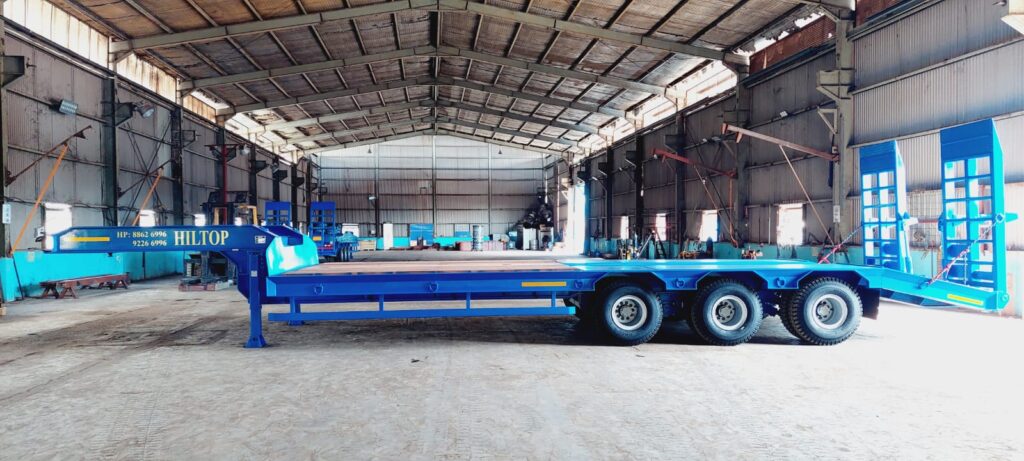
| 100 tonnes | 10.0 to 12.0 m | 800 to 850 mm | 3.0 m | 6 or more | 18 to 22 tonnes |
Tare weight matters more than most buyers expect. A heavier trailer eats into your legal gross weight and burns more fuel on every empty run. But go too light and the frame flexes under point loads. The balance comes from steel grade and web design, not guesswork.
Frustrated that no two fabricators quote the same specs for the same tonnage? That is normal. Deck length, neck design, and steel grade all shift the numbers. Ask for the build drawing, not just the brochure.
How Low Is a Lowbed Deck Compared to a Flatbed?
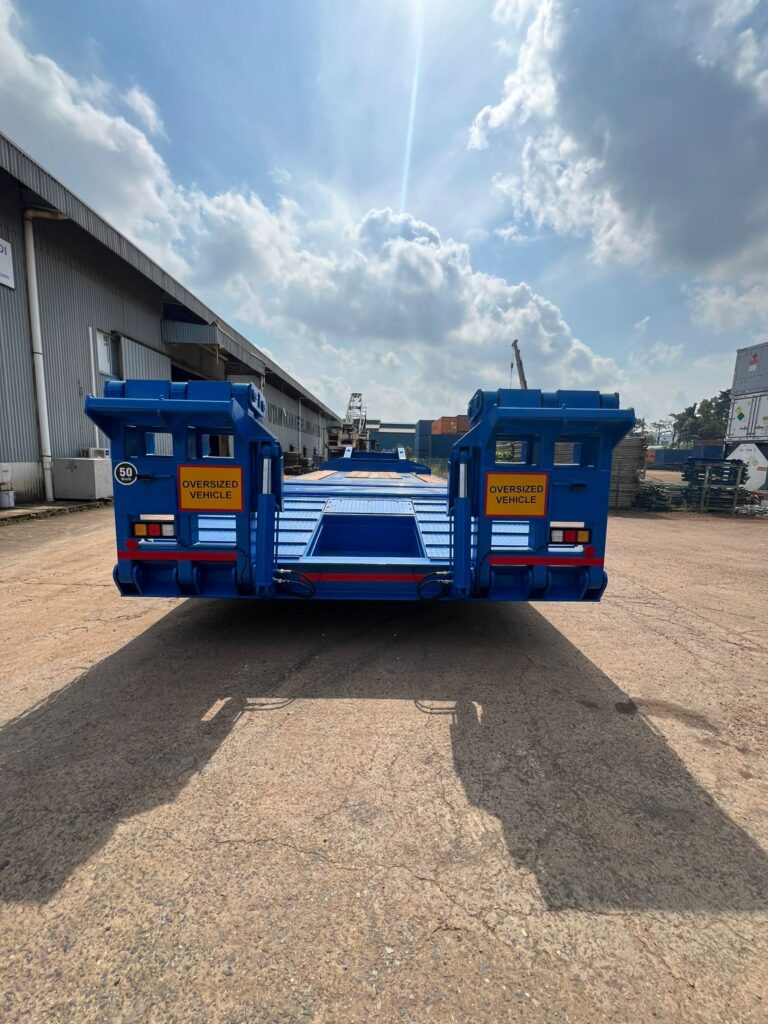
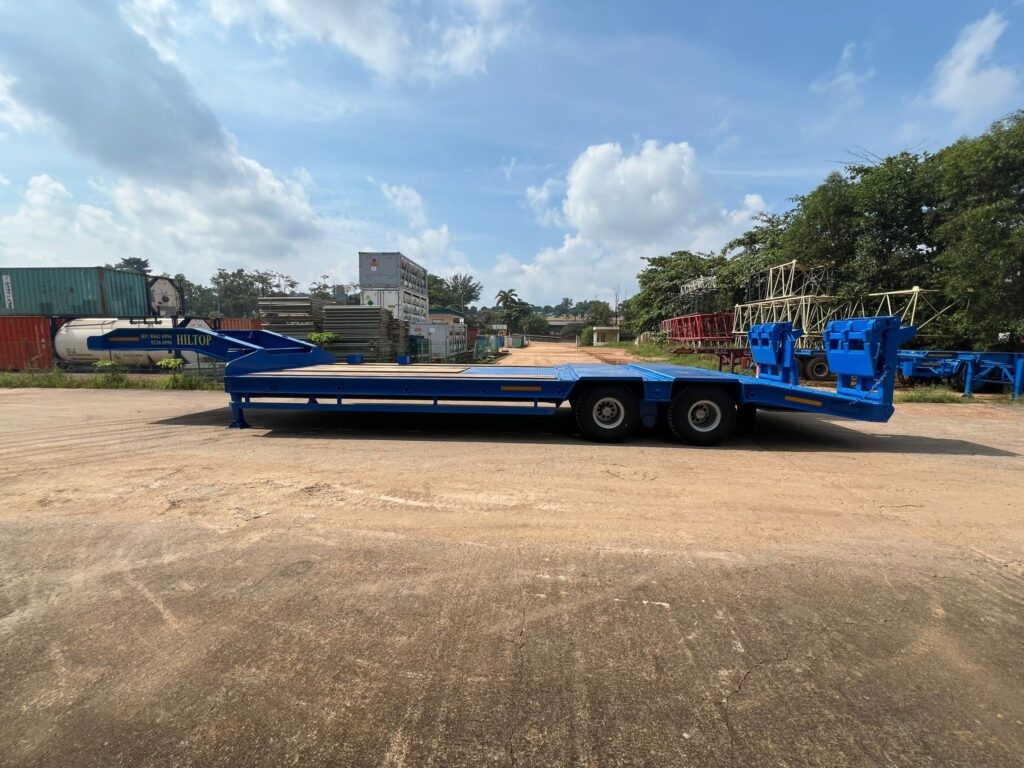
A lowbed deck sits between 800 mm and 950 mm off the road. A flatbed sits at roughly 1,400 to 1,500 mm. A semi-lowbed splits the difference at about 1,100 to 1,200 mm. That half meter is the whole reason lowbeds exist.
Do the math on a 3.2 m tall excavator. On a flatbed, the load tops out near 4.7 m. On a 900 mm lowbed deck, the same machine peaks at about 4.1 m. One setup triggers over height problems on Singapore roads. The other clears most routes without special measures.
Loads exceeding 3.4 m in width or height bring escort requirements into play in Singapore, and over height routes need planning around bridges and gantries. So, every millimetre of deck height you remove buys back cargo height. This is why demolition contractors moving 45 tonne tracked machines specify full lowbeds, not semi-lowbeds.
The exception is ground clearance. A very low deck can scrape on ramps, humps, and yard entrances. If your sites have steep access, tell your fabricator. The neck and rear bogie can be designed around it.
What Axle Configuration Do You Need for a 50 Tonne Excavator?
A 50-tonne excavator needs a 3-axle lowbed as a working minimum, and a 4-axle build gives you margin. The logic is simple arithmetic. Singapore practice caps load per axle, so total weight must spread across enough axle lines to keep each one legal.
Take a 50-tonne machine on a 3-axle trailer with a tare of 12 tonnes. Gross trailer load lands near 62 tonnes. Part of that weight transfers through the gooseneck onto the prime mover. The remainder divides across the three rear axle lines. Push each axle near its limit and you pass. Add a wet day, an off-centre load, or a worn suspension, and you do not.
That is why fleets ordering for 60 to 100 tonne cargo specify 4 to 8 axle lines. More lines mean lower load per axle, less deck stress, and fewer inspection surprises. It also means higher tare and cost, so nobody should buy more axles than the load profile needs.
Look, the honest answer is that axle count follows your heaviest regular load, not your average one. PT Metalindo builds to the load profile you supply, from 3-axle 40 tonne units up to 100 tonne multi-axle builds, and publishes the axle loading on the build drawing so your compliance team can check it before steel is cut.
We’re ready to assist with choosing the ideal truk chassis for your logistics operations, be it for industrial use, commercial fleet expansion, or new startup ventures.
Ramps, Goosenecks, and Deck Plating: The Options That Earn Their Cost
Three option choices shape how a lowbed performs day to day. None of them are cosmetic.
Which Ramp Type Suits Your Machines?
Spring-assisted twin ramps handle most wheeled and tracked plant. Hydraulic ramps cost more and load faster, which matters for rental fleets doing several transfers a week. Ramp angle is the figure to check. A shallow angle protects low-clearance machines like rollers and scissor lifts from grounding at the top of the ramp.
Fixed or Detachable Gooseneck?
A fixed gooseneck is lighter, cheaper, and stronger for its weight. A detachable gooseneck lets you load from the front at ground level, which crane companies use for boom sections and counterweights. If your cargo never needs front loading, the detachable option is money spent on a feature you will not use.
How Thick Should Deck Plating Be?
Standard chequered plate at 6 mm serves wheeled machinery well. Tracked excavators and dozers chew through that. For repeated tracked loading, 8 to 10 mm plate over closer cross-member spacing is the difference between a deck that lasts and a deck that cracks in two years. It adds tare weight, so specify it where the duty cycle justifies it.
You can see how these choices come together on delivered builds in the PT Metalindo portfolio, which shows lowbed, skeletal, and platform builds for Singapore and Indonesian fleets.
Why Specs From the Factory Beat Specs From a Catalog
Catalog trailers fit catalog loads. Real fleets carry a mix, a 30-tonne excavator today, crane counterweights next month, a piling rig after that. The spec that works is the one drawn around your actual cargo list and your actual routes.
This is where buying from a fabricator changes the process. PT Metalindo has fabricated trailers and chassis in Batam for 30 years, and the factory is under an hour from Singapore by ferry. You can inspect the steel, watch the build, and check the welds before delivery. Compare that with a container ship arriving from a factory you have never seen.
The full range for the Singapore market, including 40 to 100 tonne lowbeds, is detailed on the lowbed trailer Singapore page. Chassis, cargo cages, and custom steel builds are covered on the main site.
Specs also drive price. Steel grade, axle count, gooseneck type, and deck plating each move the final number. A detailed cost breakdown by tonnage class is coming in our lowbed trailer price guide for Singapore.
Frequently Asked Questions
What size lowbed trailer fits a 30-tonne excavator in Singapore?
A 40-tonne rated lowbed with a 9 to 10 m deck handles a 30-tonne excavator with margin for buckets and attachments. Check the machine’s transport height against the deck height. On a 900 mm deck, a 3.2 m tall excavator travels at about 4.1 m overall, which clears most Singapore routes.
How many axles does a 100-tonne lowbed trailer need?
A 100-tonne lowbed typically runs 6 or more axle lines. The load spreads so each axle stays within legal limits, with part of the weight carried by the prime mover through the gooseneck. Exact axle count depends on tare weight, deck length, and the load’s footprint, so it is set at the design stage.
What is the tare weight of a 40-tonne lowbed trailer?
A 3-axle 40 tonne lowbed typically weighs 10 to 11 tonnes empty. Heavier deck plating, a detachable gooseneck, or a wider deck push tare up. Lower tare leaves more legal payload, so compare tare figures when you compare quotes.
Should I choose a detachable or fixed gooseneck?
Choose detachable only if you need ground-level front loading, which is common for crane parts and very low machines. For standard rear-ramp loading of excavators and plant, a fixed gooseneck is lighter, cheaper, and has fewer moving parts to maintain.
Get the Spec Right Before the Steel Is Cut
The right lowbed trailer starts with four numbers: deck length, deck height, axle count, and tare weight. Match them to your heaviest regular load and your tightest route, and the trailer earns its keep for a decade. Miss them, and you own a compliance problem on wheels.
Send your cargo weights, dimensions, and site access details to PT Metalindo. The factory will return a build spec and drawing you can put in front of your compliance team before you commit. Thirty years of builds for Singapore fleets stand behind the numbers.