
LTA Type Approval and Registration for Imported Lowbed Trailers
The Question Every Buyer Asks Before Signing
Yes, a Batam-built lowbed trailer can be registered for Singapore roads. The route runs through LTA’s Vehicle Inspection and Type Approval System, known as VITAS, followed by a physical inspection at an LTA-Authorised Inspection Centre and final registration at LTA. Trailers and low loaders with a maximum laden weight above 5,000 kg also need a Vehicle Parking Certificate before registration.
That is the short answer. The long answer is why some imported trailers sail through and others sit in a yard burning money on rework.
You might feel nervous committing six figures to an overseas build without knowing it will pass. Fair. This guide walks the process step by step, lists the documents, flags the failures that cause rework, and explains how PT Metalindo builds so the inspection is a formality, not a gamble.
How Do You Register an Imported Lowbed Trailer in Singapore?
The process follows a fixed sequence. Miss a step and the timeline resets, so it pays to know the order before the trailer leaves the factory.
| Step | What Happens | What You Need Ready |
| 1. Import clearance | Trailer is shipped from Batam and cleared through Singapore customs | Commercial invoice, packing list, import permit |
| 2. Approval application | Technical submission goes into LTA’s VITAS system | Build drawings, weight documentation, component certificates |
| 3. In-principle approval | LTA reviews the submission and grants approval to proceed | A submission that matches the physical trailer exactly |
| 4. Inspection | Trailer is inspected at an LTA-Authorised Inspection Centre | The trailer, built as drawn |
| 5. Approval certificate | Passing inspection triggers issue of the vehicle approval certificate | Clean inspection result |
| 6. Registration | Documents are submitted to LTA and the trailer is registered | Registration form, ACRA business profile, Vehicle Parking Certificate, insurance |
Here’s the thing about that sequence. Steps 1 through 5 go smoothly or badly based on decisions made at the factory, months earlier. The inspection does not test your paperwork skills. It tests the build.
What Does LTA Actually Check on a Lowbed Trailer?
Four technical areas decide the result.
Lighting and Markings
Position lamps, brake lamps, indicators, and reflectors must sit at compliant heights and spacings, and rear markings must meet visibility requirements. Wiring that works is not the standard. Wiring that is routed, protected, and positioned to specification is the standard.
Braking System
The trailer’s braking must be compatible with Singapore prime movers and perform to requirement under load. Imported trailers built for markets with different braking conventions are a classic rework case. The brake system must be specified for Singapore from the first drawing.
Weight Certification
Declared tare weight, maximum laden weight, and axle loadings must be documented and must match what the scale says. A trailer that weighs in heavier than its papers is a fail. So is an axle loading table that does not add up.
Structural and Dimensional Compliance
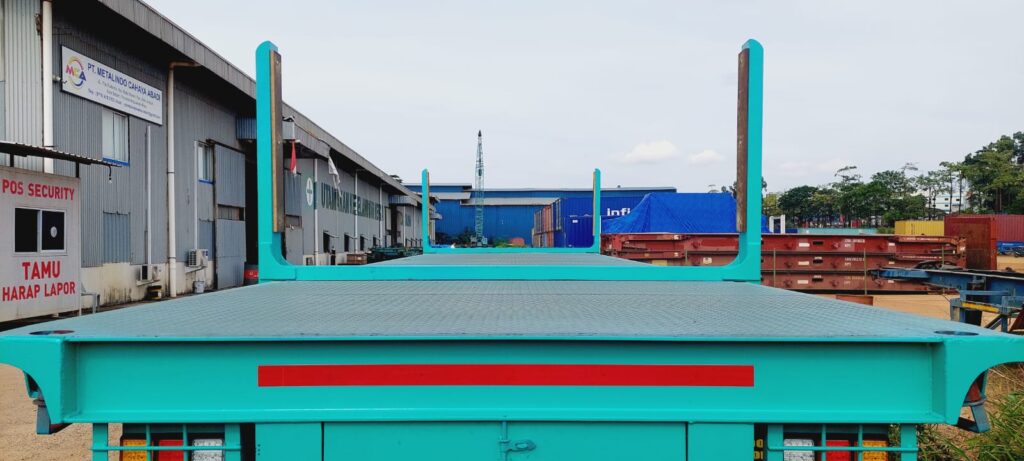
Overall width, length, coupling height, and underrun protection must sit within regulatory limits. A deck built 100 mm too wide for its category is not a small mistake. It is a rebuild.
It’s frustrating when a trailer fails on details like lamp spacing after arriving on time and on budget. Every one of these failures is preventable at the design stage, which is exactly where a fabricator earns its keep.
Why Do Imported Trailers Fail and How Do You Avoid Rework?
Most failures trace back to one root cause. The trailer was built for a generic market, then pointed at Singapore afterward.
Common rework cases follow a pattern. Lighting positioned for another market’s rules. Braking components that need swapping for local compatibility. Missing or mismatched weight documentation. Dimensions that drifted from the drawing during fabrication. Each one costs weeks and workshop fees, and each one was avoidable before steel was cut.
Want to know the secret? It is not a secret. Build to the Singapore requirement from day one and have the documentation follow the build, not chase it. PT Metalindo fabricates trailers to meet the regulatory requirements of Singapore’s LTA and Indonesia’s Ministry of Transportation, with LTA-compliant builds registered and running in Singapore today and builds delivered for Port of Singapore Authority contractors through a third party. Port work carries some of the strictest documentation demands in the market. Builds that clear that bar treat a standard registration as routine.
The factory sits under an hour from Singapore by ferry, so buyers can inspect the build against the drawing before shipment. Catching a deviation in the workshop costs nothing. Catching it at the inspection centre costs weeks.
How Long Does LTA Approval Take for an Imported Trailer?
Plan in weeks, not days. The technical submission and review take time, the inspection slot needs booking, and registration follows only after a clean pass. A first-time importer working alone can lose months to resubmissions. A fabricator that has run the process before compresses it, because the submission package is right the first time.
For a Metalindo build, typical time from trailer arrival in Singapore to registered road use is [confirm: X to X weeks]. Delivery of the build itself from the Batam factory runs [confirm: X to X weeks] from confirmed drawing, which is worth comparing against the six months or more quoted by European manufacturers before freight.
The exception to every timeline is a submission that does not match the trailer. Nothing slows registration like an inspector finding a difference between the drawing and the deck. Consistency between paper and steel is the whole game.
Who Handles the Paperwork When You Buy From a Fabricator?
Responsibility splits, and knowing the split prevents gaps. The fabricator owns the build documentation: drawings, weight certification, component certificates, and compliance specifications. The importing owner or their appointed agent handles customs clearance, the LTA application, insurance, the Vehicle Parking Certificate, and registration fees.
PT Metalindo supplies the full technical documentation package with each build so your agent submits once, not three times. Fleet buyers who run their own compliance teams get the axle loading tables and drawings up front for internal review before the order is confirmed. The full lowbed range for the Singapore market is on the lowbed trailer Singapore page, with delivered builds in the portfolio and the wider chassis and custom steel range on the main site.
Frequently Asked Questions
Does a Batam-built lowbed trailer need LTA type approval before use in Singapore?
Yes. Every imported trailer must clear LTA’s approval process through the VITAS system and pass inspection at an LTA-Authorised Inspection Centre before registration. Origin does not exempt any trailer. What origin changes is risk, and a trailer fabricated to Singapore requirements from the start passes without rework.
What documents are required to register a foreign-built trailer in Singapore?
The core set includes the technical submission with build drawings and weight certification for approval, then the registration form, the company’s ACRA business profile printout, insurance, and a Vehicle Parking Certificate for trailers with maximum laden weight above 5,000 kg. Your fabricator supplies the technical documents. You or your agent supplies the corporate and administrative ones.
What happens if an imported trailer fails LTA inspection?
The trailer must be rectified and re-inspected. Failures on lighting or markings mean workshop time. Failures on braking or dimensions can mean major rework or component replacement. Costs land on whoever the purchase contract says they land on, which is why the contract should state that the fabricator delivers an LTA-compliant build.
How long does the whole process take from order to registered trailer?
Fabrication in Batam runs [confirm: X to X weeks] from confirmed drawing, and registration in Singapore adds [confirm: X to X weeks] after arrival. The biggest schedule risk is not the process itself. It is rework from a build that does not match Singapore requirements, which can add months.
Pass on the First Attempt or Pay Twice
Registering an imported lowbed trailer in Singapore is a sequence, not a mystery: VITAS submission, in-principle approval, inspection, certificate, registration. Trailers fail when they were built generic and papered later. Trailers pass when the Singapore requirement shaped the drawing before the first weld.
Send your cargo weights, dimensions, and delivery date to PT Metalindo. The build comes back drawn to LTA requirements with the documentation package your agent needs, from a factory whose trailers are already registered and running on Singapore roads. Ask for the drawing, check it with your compliance team, and put the inspection risk where it belongs: on the fabricator’s side of the table.